
Love on Four Legs and in Circles
A few weeks ago, a friend called late on a Friday afternoon. She sounded shaken.
She asked if I would do something I'd never done before.
Two days earlier, a beloved community dog named Mia had been struck and killed by a speeding hit-and-run driver. Thinking out loud, my friend wondered if I would facilitate a grief gathering for Mia's owner, herself and her husband, and another couple who had all fallen in love with this sweet, people-loving pup. She wanted to offer the session as a gift.
At first, I wasn't sure I was the right person.
I love dogs, but I hadn’t shared my life with one in years. I wondered whether I understood this kind of loss well enough.
Then I remembered something I regularly tell others. Grief support isn't built on identical experiences. It's built on a foundation of presence.
So we gathered on Monday evening in Mia's home.
Before the others arrived, I spent some time with Mia's owner. She wanted to tell me the whole story — how they found each other, joyful moments from their two short months together, and the heartbreaking way those months came to an end.
She had only one request for the group. Please don't talk about the accident.
This made perfect sense. Just days after a traumatic loss, replaying the details can hurt more than it helps. We agreed that our time together would focus on Mia's life.
After a few grounding breaths, participants began by writing about Mia and what she meant to each of them personally. Some read their words out loud, sharing stories others were hearing for the first time. They all witnessed and nodded along.
The room quickly filled with laughter, tears, and memories.
One couple lovingly referred to themselves as Mia's auntie and uncle. They laughed about how she insisted on squeezing between them on the couch during movie nights at their place. Her owner smiled as she described Mia resting one little elbow in her lap while she sat reading on the porch and how she raced to the front door the moment she heard the car pull into the driveway.
One neighbor still takes the same daily walk they once shared together. Sometimes he even brings Mia's leash with him.
Her bark. The divot she left in the back of the couch. Her strong opinions. Her endless desire to be as physically close to her people as possible.
"She was a cuddler."
Listening to the stories, it became clear that grief isn't always measured by time. Sometimes it's measured by attachment.
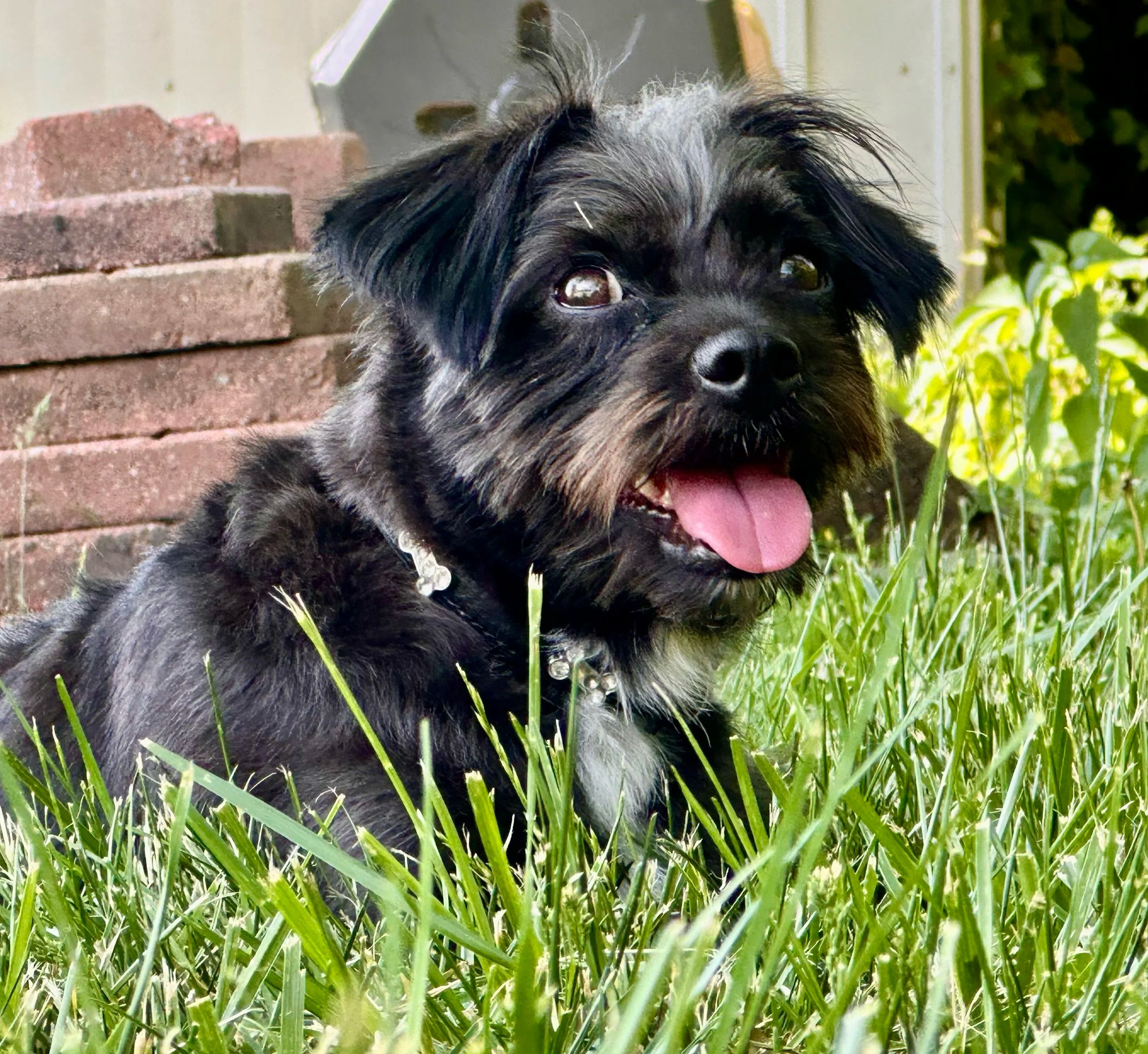
Beautiful Mia.
One part of the group session was unexpected and important to explore. It wasn't actually about Mia.
Mia's owner shared how badly she felt about waking one of the couples right after the accident. She didn't want to burden them, but she was terrified and didn't know what else to do.
They both responded without hesitation from opposite sides of the circle, "We would've been more upset if you hadn't called us." They wanted to be there for her.
The owner’s comment is something I’ve said myself, and people I know and work with have said it too. So many of us carry that same fear. We worry that our grief is too much; that we'll be a burden to others if we ask for help.
But these neighbors confirmed something beautiful. We aren’t a burden when we let people care for and support us.
Near the end of the session, I invited everyone outside for one of my favorite grief practices.
For ten minutes we wandered around the property looking for awe.
When we returned to the circle, someone talked about flowers they'd walked past every day but had never really noticed. Someone else watched a baby squirrel playing on a rooftop. Another neighbor wandered next door and tried out the new playground equipment at the empty elementary school.
Just ten minutes. Nothing had actually changed, but everyone felt a little lighter, having shifted their focus in search of awe.
Driving home afterwards, I felt good about my work that evening. I'd witnessed much more than the suffering from the loss of a beloved dog.
I saw how stories can be soothing when traumatic details are nagging at us.
Love proved (once again) that it isn't always measured in months.
I watched neighbors become even more of a community and share openly that they are there for one another.
I saw how being witnessed can change the energy of grief, something that still amazes me.
And I walked away with a lesson of my own. (My work is always teaching me something!)
I showed up ready, but still wondering whether I was the right person for the job. I left remembering that my role isn't to have experienced every kind of loss. It's to create spaces where people can bring theirs.
It’s not lost on me that weeks into grieving my mom, I found myself once again sitting in a circle of people teaching me what love looks like after loss.
I still think about Mia every day since that session.
I never got to meet her, but it’s sort of astounding how in two short months she somehow wove three households a little closer together.
Even after she was gone, Mia was still bringing people together. What a perfect gift!
The gathering itself was a gift too.
One compassionate and thoughtful neighbor recognized that she and others were hurting and found a way to gather for a time to remember, cry, laugh, and care for one another.
This wasn’t the first time someone was given one of my grief support sessions as a gift. Flowers and meals are certainly thoughtful gestures, but offering a space to have our grief witnessed and to process loss with support may be one of the most meaningful gifts we can give.
Do you know someone who needs reminding that they don't have to grieve alone?
If this essay found its way to you through a friend, welcome.
Join here for more.